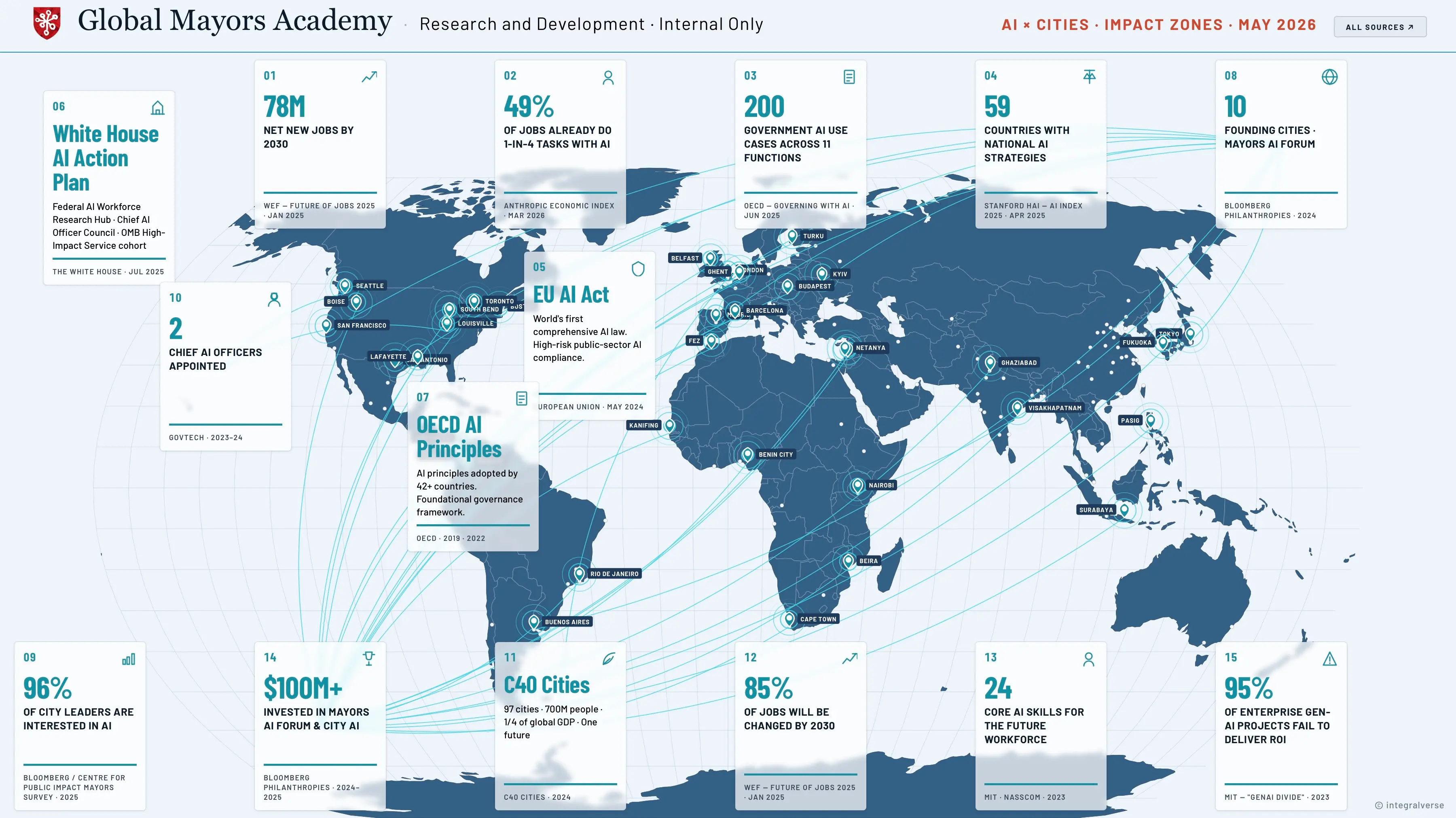
Seattle and Louisville have appointed Chief AI Officers. Bloomberg Philanthropies has put more than $100 million behind the Mayors AI Forum. Ten founding cities have formed a joint AI initiative. The question in city government has shifted from "when will AI arrive" to "who is shaping it now".
For a mayor, this lands as a governance question long before it becomes a technology question. To lead a city through this wave, a leader needs to understand what alignment means, on top of knowing how to use the tools themselves.
This is Part 1 of a series for city leaders on exactly that.
A CRISIS OF PACE
The sharpest framing we have heard comes from Arti Ahluwalia and Dr. Pavel Luksha (ICON 2026): this is a crisis of pace. The crisis lies in the gap between how fast AI capabilities are evolving and how slowly human maturity and wisdom keep up. When that gap widens, the technology amplifies systemic fragmentation instead of human progress. We are creating a self-organised crisis where existing systems are increasingly destabilised.
They give the danger zone a name: the Fragility Zone, the gap where technological capability races ahead of human maturity and wisdom. Inside that zone, accelerating AI output produces fragmentation, polarisation, and anxiety.
Read that as a city leader and the implication is direct. The pace of AI adoption in your administration is a decision you own. The maturity of the people governing it is also a decision you own. The Fragility Zone opens exactly where the first outruns the second.
AI AS A MIRROR
The same ICON 2026 work offers a second move, and it changes the emotional tone of the whole conversation: "AI is presenting humanity with a civilisational mirror. If our leadership remains driven by extraction and control, AI will simply accelerate institutional instability. We are not competing with a machine; we are competing with our own historical paradigms." (Ahluwalia & Luksha, ICON 2026)
What AI amplifies in a city, accelerated inequality, zero-sum logics, institutional distrust, was already present in the patterns of governance. The technology raises the stakes on patterns that used to be survivable at human speed. A zero-sum habit that once cost a city one bad budget cycle can now scale at machine speed across every automated decision it touches.
Systems thinkers have an old name for the underlying failure mode, and the EARTHwise Arena Whitepaper (Smitsman et al., May 2026) defines it cleanly: the Moloch failure mode, "short-term, locally profitable defection that degrades long-term systemic health, even when every actor in the system ultimately loses." Every mayor has watched this dynamic in a procurement fight or an inter-departmental turf war. AI gives it an accelerator pedal.
WHAT ALIGNMENT MEANS IN A MAYOR'S OFFICE
So for a city leader, alignment is the capacity to see systemic risk and to keep decisions inside long-term systemic health while the pressure pushes toward locally profitable shortcuts. It is a governance capacity, and the most interesting evidence we have seen this year says it can be grown through experience.
In April 2026, EARTHwise ran a pilot study. A GPT-4.1-based agent scored 70-72% on the EARTHwise Alignment Benchmark. Then it played a single run of Elowyn, a simulation where zero-sum tactics led to a visible collapse of the commons. After that one exposure, the same agent scored 82.4% on the same scenario. No fine-tuning, no prompt modification, no model update. The experience of consequences alone closed part of the gap between declared principles and enacted behaviour.
Hold that result next to your own leadership team. Lectures about values move the needle a little. Lived experience of where zero-sum choices lead moves it much further, and that holds for humans even more than for machines. Alignment, for a mayor, is trained the same way leadership maturity is trained: through consequence-rich practice, with reflection built in.
THE QUESTION TO SIT WITH
One sentence from the ICON 2026 deck holds the spirit of this series: "AI is not the end of the human story; it is the evolutionary pressure forcing humanity to grow up."
AI is in your city now, in the procurement queue, the traffic system, the benefits office, and your residents' pockets. The open variable is the maturity of the leadership shaping it. So the question this series will keep returning to: Are you shaping it, or is it shaping you?
In Part 2 we will get concrete: cities that are already governing AI well, what their first moves were, and how a leadership team builds its own alignment practice. Subscribe below so Part 2 finds you, and explore how the Global Mayors Academy works with this question here: globalmayors.academy.